Why Canadians Often Pay Less for the Same Pills: A Look Behind Canada's Drug Pricing System

Photo: Canadian pharmacy medication pricing pills prescription bottles Canada flag, via image.shutterstock.com
If you have ever compared the price of a common medication at a Canadian pharmacy with its cost in the United States, the difference can be startling. The same brand-name drug, manufactured by the same company, can carry a price tag that is two, three, or even four times higher south of the border. This disparity is not accidental. It is the direct result of deliberate policy choices, regulatory structures, and purchasing strategies that have been built into Canada's pharmaceutical system over decades.
Understanding why Canadian drug prices tend to be lower — and how that benefits patients who access medications through reputable Canadian pharmacies — is both practically useful and genuinely illuminating.
The Role of the Patented Medicine Prices Review Board
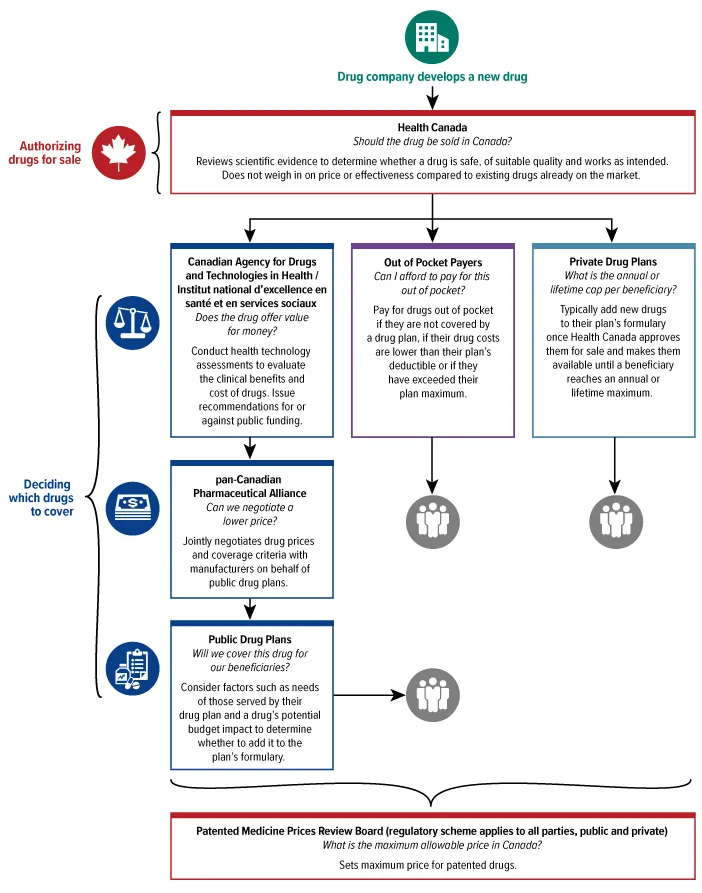
At the centre of Canada's drug pricing architecture sits the Patented Medicine Prices Review Board (PMPRB), a federal regulatory body established in 1987. The PMPRB's mandate is to ensure that the prices charged by pharmaceutical manufacturers for patented medications in Canada are not excessive.
To carry out this mandate, the PMPRB compares the prices of patented drugs in Canada against those in a basket of comparator countries. For years, this basket included countries such as France, Germany, the United Kingdom, Italy, Sweden, Switzerland, and the United States. Recent regulatory reforms have sought to update this framework to better reflect international pricing realities and to further constrain the ceiling prices that manufacturers may charge in Canada.
While the PMPRB does not set the retail price that patients pay at the pharmacy counter, it establishes an upper boundary for what manufacturers can charge wholesalers and distributors. This ceiling has a meaningful downstream effect on consumer prices, particularly for patented brand-name medications.
Provincial Formularies and Bulk Purchasing Power
Beyond federal regulation, Canada's provinces and territories exercise considerable purchasing power through their public drug benefit programmes. Each province maintains a formulary — a list of medications eligible for public reimbursement — and negotiates confidential rebates with pharmaceutical manufacturers in exchange for formulary listing.
Through the pan-Canadian Pharmaceutical Alliance (pCPA), provinces pool their negotiating resources to secure lower prices for both brand-name and generic medications. The pCPA has been operational since 2010 and has completed negotiations on hundreds of drug products, consistently achieving price reductions that benefit public payers and, by extension, patients covered under provincial drug plans.
This collective bargaining model is fundamentally different from the fragmented, payer-by-payer negotiation that characterises pharmaceutical purchasing in countries without universal health coverage. When provinces negotiate as a bloc, manufacturers face a choice between accepting lower prices or losing access to a significant portion of the Canadian market. The result is downward pressure on prices that ultimately benefits all Canadian patients.
Generic Drug Pricing: A Structural Advantage
Canada has also taken deliberate steps to reduce the cost of generic medications, which account for the majority of prescriptions dispensed in this country. Historically, generic drug prices in Canada were higher than in several comparable nations, a disparity that prompted federal-provincial negotiations resulting in the Generic Drugs Pricing Agreement.
Under this framework, the price of the most commonly dispensed generic medications was reduced to 18 percent of the reference brand-name price — a benchmark that made Canadian generics among the most affordably priced in the developed world for the covered products. While not every generic drug falls under this agreement, the initiative has produced measurable savings for patients and provincial drug programmes alike.
For patients managing chronic conditions that require long-term medication use, the cumulative savings from lower generic prices can be substantial. A patient taking a daily statin for cholesterol management or a daily antihypertensive, for example, may save hundreds of dollars annually compared to what they would pay for the same medication in an unregulated pricing environment.
Concrete Examples of the Pricing Difference
To appreciate the scale of Canada's pricing advantage, it helps to consider specific examples.
Humira (adalimumab), a biologic medication used to treat rheumatoid arthritis and other inflammatory conditions, has been cited repeatedly in cross-border pricing comparisons. The list price in the United States has historically exceeded $70,000 USD annually for a standard course of treatment. In Canada, the same medication carries a significantly lower list price, and biosimilar alternatives — which Canada has actively promoted — are priced lower still.
Sovaldi (sofosbuvir), a hepatitis C treatment, was priced at approximately $84,000 USD for a twelve-week course in the United States at launch. Canadian negotiations secured substantially lower prices, enabling provincial drug plans to expand access to this life-altering treatment.
Even for more common medications such as Lipitor (atorvastatin), Crestor (rosuvastatin), and Synthroid (levothyroxine), cross-border price comparisons consistently show Canadian pharmacy prices that are meaningfully lower than uninsured prices in the United States.
How Patients Can Leverage the Canadian Pricing Advantage
Understanding that Canadian drug prices are regulated and generally lower than in many comparable markets is the first step. Knowing how to act on that knowledge is equally important.
Discuss therapeutic alternatives with your physician. If you are prescribed a brand-name medication with a high cost, ask your doctor whether a therapeutically equivalent generic or biosimilar is available. Canadian pharmacists are also valuable resources for this conversation and can often identify lower-cost alternatives that are covered under your provincial formulary.
Review your provincial drug plan's coverage. Many Canadians are eligible for provincial drug benefits they are not actively using. Seniors, low-income individuals, and patients with certain chronic conditions may qualify for subsidised coverage that further reduces out-of-pocket costs.
Use a licensed Canadian pharmacy for your prescriptions. Accessing medications through a reputable, licensed Canadian pharmacy — one that operates in full compliance with provincial regulatory standards — ensures that you benefit from the pricing protections built into Canada's pharmaceutical system. Canadian Pharmacy Stock is committed to providing Canadians with access to their prescribed medications at prices that reflect Canada's regulated market.
Inquire about manufacturer assistance programmes. Even within Canada's regulated pricing environment, some high-cost specialty medications may still represent a financial burden. Many manufacturers offer patient assistance programmes for eligible Canadians, and your pharmacist or social worker can help identify applicable options.
A System Built on Collective Benefit
Canada's lower drug prices are not the result of compromise on quality or safety. Health Canada's regulatory standards for pharmaceutical products are among the most rigorous in the world, and medications dispensed by licensed Canadian pharmacies meet the same standards of efficacy and safety as those available anywhere. The pricing difference reflects a deliberate policy choice: that access to essential medications should not be determined solely by a patient's ability to pay, and that the collective purchasing power of the Canadian population is a resource to be used in the public interest.
For Canadians, this means that every prescription filled through a licensed domestic pharmacy is backed by decades of regulatory work designed to keep costs fair. That is an advantage worth understanding — and worth using.